We tend to think of artificial intelligence as something profoundly unnatural—a technological creation made from silicon, copper, data centers, and electricity.
But there may be another way to look at it.
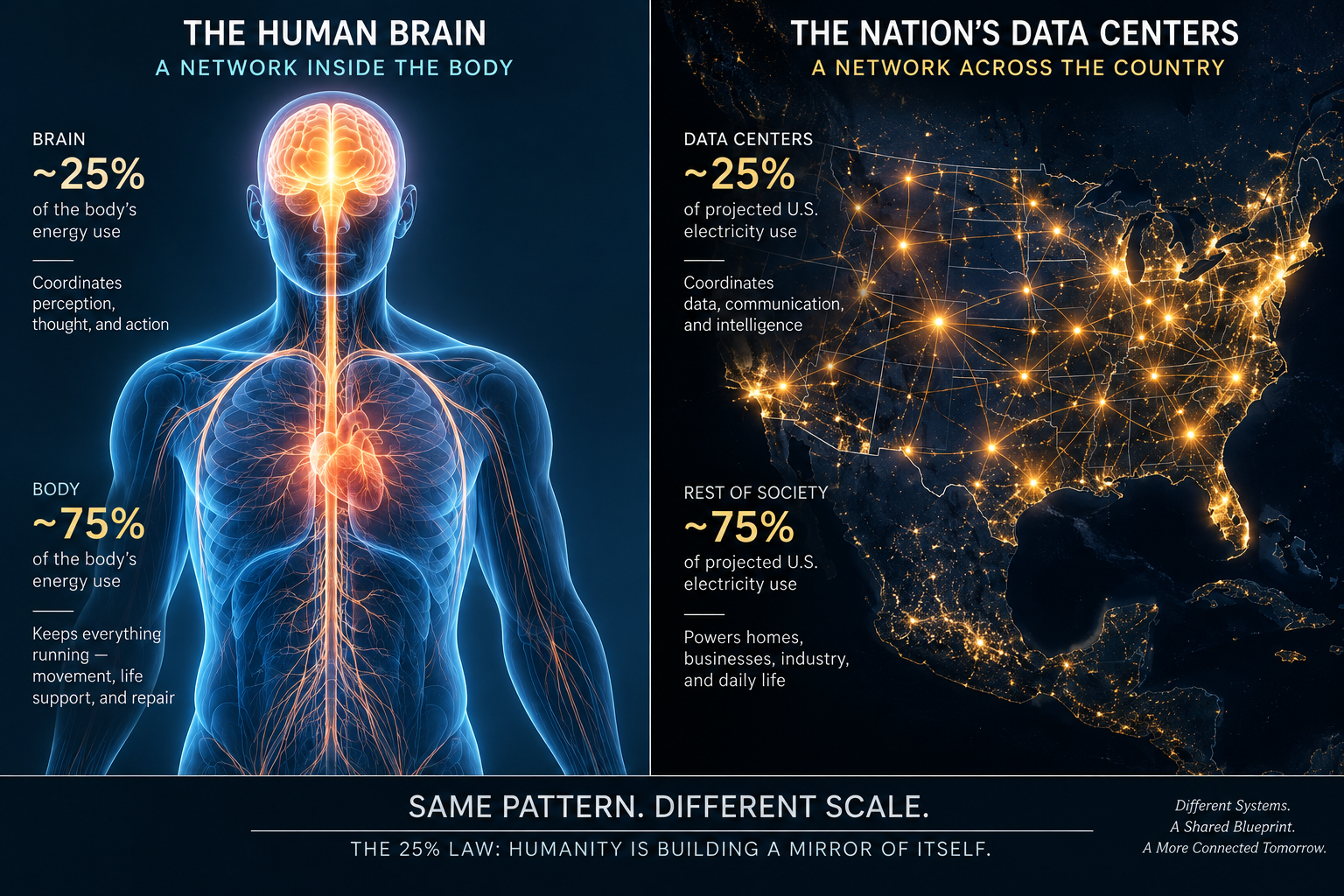
As digital society expands, an intriguing parallel is emerging between the way energy is distributed inside the human body and the way energy is increasingly being consumed by the world’s digital infrastructure. The similarity raises a provocative possibility:
Human civilization may not simply be inventing artificial intelligence. We may be recreating, at planetary scale, the same organizational logic already found within ourselves.
The human brain is an extraordinarily energy-intensive organ. Though it represents only a small fraction of the body’s mass, it consumes a remarkably large share of the body’s available energy. Its disproportionate energy demand reflects the enormous amount of information processing, coordination, signaling, memory, and decision-making taking place within it.
Now consider what is happening to society.
For most of industrial history, electricity powered primarily physical activities: lighting homes, running factories, moving machinery, heating buildings, and operating transportation systems. Increasingly, however, enormous quantities of energy are being redirected toward information processing—data centers, cloud computing, telecommunications, machine learning, and artificial intelligence.
In other words, civilization is beginning to devote a growing share of its energy not merely to moving matter, but to processing information.
That is exactly what a brain does.
This is where the idea of the 25% Law becomes interesting. If the energy devoted to computation and information processing eventually approaches roughly the same proportion that biological organisms devote to their own nervous systems and brains, then the parallel becomes difficult to dismiss as merely poetic.
The similarity is not that a data center physically resembles a brain.
It is that both systems may obey a deeper organizational principle:
As a system becomes more complex, an increasing proportion of its available energy must be devoted to sensing, communicating, coordinating, remembering, predicting, and deciding.
A brain performs those functions for a body.
Our emerging digital network increasingly performs them for civilization.
Seen this way, the rapidly growing web of data centers, fiber-optic networks, sensors, satellites, mobile devices, and AI systems begins to resemble a planetary nervous system. Individual data centers could be thought of less as isolated machines and more as processing nodes within an increasingly interconnected whole.
And that leads to an even more provocative thought.
Perhaps intelligence is not something nature invented once and humanity is now artificially reproducing. Perhaps intelligence is what complex systems naturally begin to build when they reach a certain scale.
Cells formed nervous systems.
Nervous systems formed brains.
Human beings formed societies.
And societies may now be constructing their own information-processing layer.
From this perspective, artificial intelligence becomes somewhat less artificial.
It may represent the next recurrence of a much older pattern: matter organizing itself into increasingly sophisticated centers of sensing, information processing, coordination, and response.
The most interesting question, then, may not be whether machines will someday become like us.
It may be whether, without fully realizing it, we have been building something in our own image all along.
For the full paper, click here.